How to compare remodel quotes line by line (before you sign)
You have three remodel quotes for the same job, and they look nothing alike. One is a single page with a big total. One is six pages of line items. One says "complete kitchen" and not much else. The builder with the lowest number wants a deposit this week.
Here's the short answer to how to compare remodel quotes: don't compare the totals first. Make one list of all the work your project needs, check every quote against that same list, add a rough amount for anything a quote leaves out, and ask each builder in writing about anything that isn't clear. Only then compare prices and score the quotes.
Why comparing totals doesn't work
A total only means something when you know what's inside it. Two quotes for "a bathroom remodel" can cover very different work:
- One includes trash removal (a dumpster or haul-away). The other says nothing about it.
- One includes waterproofing (sealing wet areas so water doesn't get into walls and floors). The other doesn't mention it.
- One lists the faucets and shower set at a fixed price. The other has an allowance (a set amount of money for something you pick later) that may be too low for what you actually want.
Put those quotes side by side and you're not comparing prices. You're comparing different jobs. The lowest total can simply be the one that leaves the most out, and the gaps tend to show up later as extra bills.
Before you start: set one rule
Write down your project, the rooms, and when you'd like to start. Then write one hard rule: no deposit and no demo (tear-out) until the quotes are compared. A "small" deposit paid early makes it much harder to walk away if a quote turns out to be missing things. Still waiting on quotes? Do this step and the next one now.
Step 1: Make one master list of the work
Before you look at any prices, write down every job your project needs. This single list gets used for every quote, so each builder is measured against the same thing instead of their own layout.
Most remodels touch the same handful of areas. Use them as prompts:
- Materials and fixtures: cabinets, vanities, countertops, flooring, tile, faucets, toilet, shower set, lights, handles, trim, paint.
- Labor and trades: demolition, carpentry and drywall, plumbing, electrical, tiling, waterproofing, painting, site supervision if it's charged.
- Allowances: any line that's a set amount for something you'll choose later.
- Things left out (exclusions): work the quote says isn't included, items you buy yourself, and unknowns like rot or old wiring behind the walls.
- Permits and inspections: who applies, who pays, which inspections are assumed.
- Trash and site protection: dumpster or haul-away, floor and dust protection.
- Timeline: when they can start, how many weeks, wait times for materials.
- Warranty (their written promise to fix problems): how long they cover their own work, and whether there's a final fix-list before handover (a punch list).
- Payment schedule: the deposit, payments at each stage, and what counts as "finished."
A few tips that catch the lines people usually miss:
- Walk the room top to bottom: ceiling, walls, windows and doors, fixtures and cabinets, then the floor.
- Merge all your quotes into the list. If even one quote mentions something, it goes on your list. That's the fastest way to see what the others left out.
- Ask "who buys it, who installs it?" For anything you pick yourself, buying and fitting can be two separate lines.
It's better to have an extra line marked "doesn't apply" than to miss one. This master list is the heart of any good remodel quote checklist.
Step 2: Mark each quote with one letter per line
Now go down your list one line at a time. For each quote, write one letter:
- I = included. The quote clearly covers it.
- E = excluded. It's not in the quote. Write your rough guess of what it would cost to get done, like "E $1,200."
- A = allowance. A set amount for something you pick later. If your choice costs more, write the extra.
- ? = not clear. The quote doesn't say. Don't guess a number. Ask the builder.
- n/a = doesn't apply. It's not part of your job.
For example: Quote A says "tile allowance $40 per square foot," so you write A. Quote B says nothing about tile, so you write E for now and ask. Quote C says "tile supplied and laid," so you write I. Quote D says "tile to be confirmed," so you write ?.
Check allowances against what you've actually picked: a $2,000 tile allowance looks fine until the tile you want costs $4,000. And treat "turnkey" (ready to use) or "complete kitchen" as sales words, not a list of work. Your rough numbers don't need to be exact; they just show the size of each gap.
Step 3: Work out a comparable total
Add up the rough dollars you wrote next to every E, and any extra on A lines where the allowance is too low. Then:
Total on the quote + what's missing (rough $) = comparable total (about).
It's rough, and it doesn't cover the ? lines yet, but it's a much fairer number to compare than the printed totals.
Step 4: Ask each builder in writing
Every E, A or ? on your list is something you don't fully know yet. Write one short question for each and send them by email or text, so the answers come back in writing. A few starters that work for almost any job:
- "Is [line] included, left out, or an allowance? If it's an allowance, how much?"
- "What isn't in this price that people often think is?"
- "If you find a problem behind the walls, like rot or old wiring, how will you price it, and how will you tell me?"
- "Who applies and pays for permits and inspections, you or me?"
- "Can you write out the payment plan, and what has to be finished before each payment?"
When answers come in, update your letters and totals. If a builder promises something on site, ask them to put it in writing.
Step 5: Score the quotes, with price as only one part
Now score each quote from 1 to 5 (5 is best) on a few things that matter, give each a weight, and multiply. For example:
- Nothing missing (few E or ? marks): weight 25
- Clear price: weight 20
- Realistic timeline and good contact: weight 15
- Fair payment plan: weight 10
- Fixes and guarantee on their work: weight 10
- How extra costs are handled: weight 10
- References, license and insurance: weight 10
The weights add up to 100, so the best possible total is 500. Change them to suit you, and score what's written on the quote, not how friendly the builder was. The score is a guide, not the final answer: check each builder's license and insurance yourself and call at least one reference.
A worked example (made-up numbers)
Example only. These numbers are made up to show the method. They aren't typical prices.
Three quotes for the same bathroom remodel:
| Quote | Total on quote | What's missing (rough $) | Comparable total (about) |
|---|---|---|---|
| A | $42,000 | $2,600 | $44,600 |
| B | $38,500 | $4,000 | $42,500 |
| C | $45,000 | $400 | $45,400 |
Where the "missing" numbers came from, after marking each quote against the same master list:
- Quote A: trash removal excluded (E $1,200), and allowances for the faucets and tile that were too low for what was picked (A +$600 and A +$800). Total missing: $2,600.
- Quote B: trash removal, the faucets and shower set, and tile all left out (E $900, E $1,500, E $1,600). Total missing: $4,000.
- Quote C: only the faucet allowance was short (A +$400). But it had two ? lines: whether a wall was coming out, and how the waterproofing would be done.
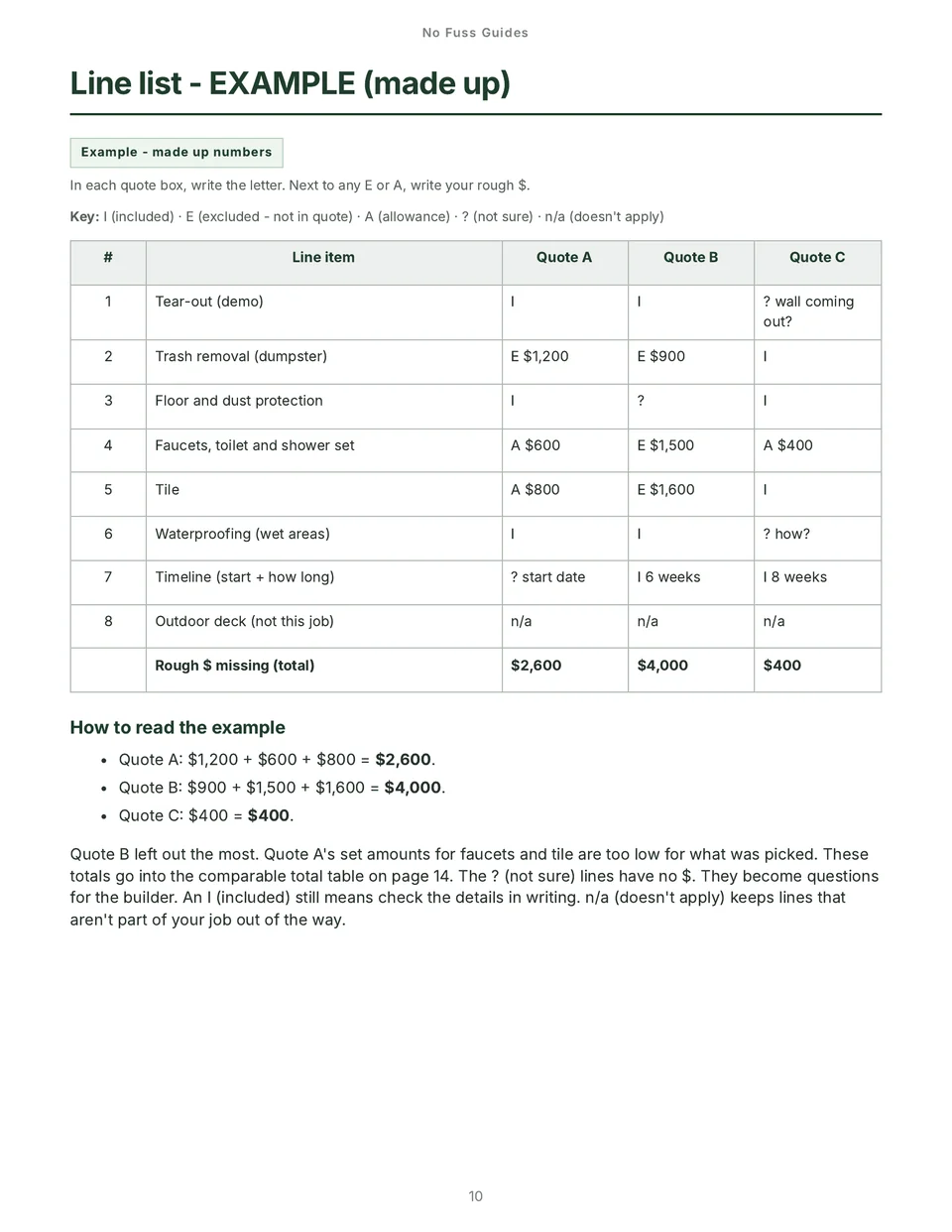
Quote B looked cheapest, $3,500 less than Quote A. After adding what's missing, the gap is only $2,100. Quote C looks most expensive, but it leaves the least out, and its two ? lines become written questions before anyone scores anything.
In the made-up scorecard, Quote C came out highest (405 out of 500). That doesn't mean "hire Quote C." It means you now know what you're comparing and what to ask.
What this method won't do
It won't pick a builder for you or promise a lower price, and it isn't legal or construction advice. It puts every quote on the same list, so the choice is yours and it's clearer.
Want the fill-in version?
If you'd rather not build all of this from scratch, The No Fuss Guide to Comparing Remodel Quotes is a 22-page fill-in PDF workbook that lays out every step above: the master list prompts, the I / E / A / ? / n/a line list for up to four quotes, the comparable total table, question starters with a tracker, and the scorecard, each with a filled-in example. Print it or use it on a tablet, and take it to builder meetings.